working hours
Monday & holidays
Closed
Tuesday to Friday
9AM to 1PM
3PM to 7PM
3PM to 7PM
Saturday
9AM to 2PM
Sunday
Closed

17310 Lloret de Mar
Sunday and Monday: CLOSED
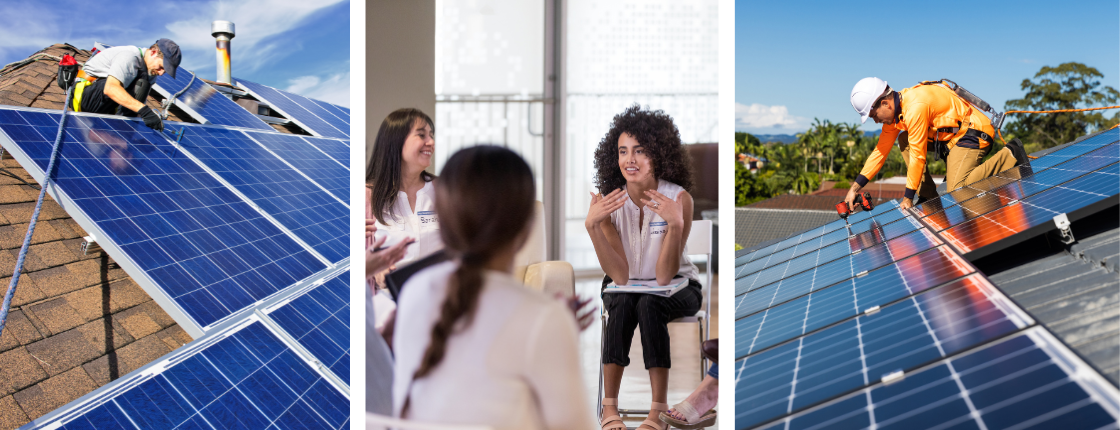
The Costa Brava (Blanes, Lloret de Mar, Tossa, Sant Feliu, Palamós, Platja d’Aro, Calonge, Sant Antoni, Palafrugell, Begur, Roses, Empuriabrava, Cadaqués…) enjoys a high level of sunshine, which makes solar panels a highly attractive investment for homeowners’ associations.
Many communities on the Costa Brava are considering installing solar panels to reduce their electricity bills and increase their building’s value. However, when they begin discussing majorities, subsidies, and responsibilities, they realize that managing the process without a property manager is highly complex.
In this article, you will learn what majorities are required, what steps need to be followed, and why bringing in a property manager might be the best decision to make your project a reality.
Installing solar panels in a homeowners’ association on the Costa Brava allows you to:
Significantly reduce the electricity bill, whether communal or individual (shared self-consumption).
Increase the property value, especially in tourist areas like Platja d’Aro, Palamós, Roses, or Lloret de Mar.
Improve the building’s sustainable image and meet increasingly demanding energy efficiency criteria.
Additionally, there are grants and bonuses that can reduce the installation cost by 40% to 50%, combining subsidies, tax deductions, and municipal bonuses.
Difficulty in convening meetings and managing proxy votes.
Complexity in interpreting the LPH (Horizontal Property Law), participation quotas, and majorities.
Managing conflicts between neighbors who support the project and those who oppose it.
Processing grants and subsidies (handling paperwork, deadlines, and justifications).
For these reasons, many communities end up seeking a property manager to coordinate the process and represent the community before suppliers and the public administration.
Installing solar panels involves altering a common element (the roof), which is regulated by Article 396 of the Civil Code and Article 17.1 of the Horizontal Property Law (LPH). The regulations distinguish between several scenarios:
Shared self-consumption / private use: This can be approved with the favorable vote of one-third of the owners representing one-third of the participation quotas.
Installations for common services (stairwell lighting, elevators, communal areas): These usually require a simple majority of owners and quotas (more votes in favor than against).
Neighbors who are against it: They are not obligated to pay if they do not benefit from the installation; however, they can join the system later by paying their proportional share of the cost.
In communities without a manager, it is usually the president or a volunteer neighbor who tries to manage the project… often resulting in overload and conflicts. A property manager can assume the responsibility of calculating quotas, preparing the meeting minutes, validating majorities, and minimizing legal risks.
Important Note: The decision must be recorded in the meeting minutes. Furthermore, according to the LPH, the annual cost (after deducting subsidies) generally cannot exceed nine to twelve months of ordinary common expenses.
Many communities on the Costa Brava are a mix of primary residences, tourist apartments, and second homes. This creates specific challenges:
Low attendance at meetings, which makes it difficult to achieve the required majorities.
Differing interests: Some neighbors want to maximize their tourist rental yields, while others are looking for annual savings on their personal consumption.
To facilitate approval, it is crucial to send preliminary information to all owners (including those living abroad or out of town) and provide savings simulations adapted to both residential and tourist usage.
In Catalonia, several lines of assistance can be combined in 2026 to reduce the community’s initial investment:
Regional self-consumption subsidies managed by ICAEN, covering up to 40% of the installation cost alongside set amounts per installed kWp.
Personal Income Tax (IRPF) deductions of up to 60% of the cost, provided the energy efficiency of the primary residence is improved.
Municipal bonuses on IBI (Property Tax) and ICIO (Construction Tax), which can reach up to 50% of the IBI for 3–5 years and up to 95% of the ICIO, depending on the municipality.
Keep in mind that there have been delays in the payment of certain grants and that funds are limited. Therefore, it is vital to submit the application with all the correct documentation and strictly within the established deadlines.
If your community does not currently have a property manager, it is highly recommended to hire one before starting a solar panel project. This ensures that grants and bonuses are processed correctly and that the savings projected in the budget translate into real financial savings.
The majority depends on how the panels will be used. For shared self-consumption among several neighbors, a favorable vote from one-third of the owners (representing one-third of the quotas) is usually sufficient under the LPH. If the panels cover common services, a simple majority is generally enough.
No, unanimity is not required in most cases. The law allows certain renewable energy projects to be approved with simple or reinforced majorities, meaning a dissenting minority cannot block the project if the required votes are reached.
Neighbors who choose not to participate are not obligated to pay their share of the investment if they do not benefit from the panels. However, the community can agree that if they wish to join the system in the future, they will have to pay their proportional share of the initial cost or a specific amount agreed upon at a meeting.
It is possible, but much more complicated. The community will have to handle convening meetings, calculating majorities and quotas, managing budgets, processing grants, and resolving neighbor disputes. For solar projects with significant legal and economic impacts, it is highly advisable to bring in a property manager to coordinate the process.
A property manager can:
Correctly interpret the Horizontal Property Law and the required majorities.
Prepare and moderate meetings to ensure clear and transparent voting.
Negotiate with installation companies and review budgets.
Coordinate the processing of subsidies and tax bonuses.
This significantly reduces the risk of internal conflicts and increases the chances of the project being approved and successfully executed.
It is helpful to prepare a brief dossier that includes: a clear explanation of what solar panels are, a savings simulation per neighbor and for the community, an outline of the required majorities, what happens to those who don’t want to participate, and a summary of available grants. Visual presentations (charts, before/after comparisons) greatly help everyone understand the project.
Yes. The Costa Brava has high solar irradiation and significant energy consumption in many primary and secondary residences. This makes photovoltaic self-consumption particularly beneficial, combining electricity bill savings with property value appreciation and a more sustainable building image.
Communities can usually apply for self-consumption subsidies, tax deductions, and municipal bonuses on taxes like the IBI or ICIO, depending on the municipality and current regulations. Before deciding, it is essential to check which grants are active, their requirements, and their application deadlines.
Transparency and upfront information are key. Sending a clear project summary before the meeting, listening to concerns, answering FAQs, and clarifying what happens to non-participants helps reduce tension. Having a property manager or a professional team structure the communication also ensures that the debate remains orderly and constructive.
The first steps usually are:
Verify the available space and the basic viability of the roof.
Request a preliminary technical and economic study.
Inform the community using a summary document.
Decide whether you want to rely on a property manager or professional support to handle the legal, economic, and communication aspects.

If your homeowners’ association on the Costa Brava is evaluating the installation of solar panels, it is crucial to combine legal analysis (LPH majorities) with a rigorous technical and economic study. Good advice can be the difference between a project blocked at a meeting and an installation that is approved, subsidized, and profitable.
We can help you:
Analyze the technical viability of the roof.
Determine what majority you need according to the LPH.
Design the presentation for the homeowners’ meeting.
Process subsidies and bonuses to maximize your savings.
| Cookie | Duration | Description |
|---|---|---|
| IDE | 13 months | Used by Google DoubleClick and stores information about how the user uses the website and any other advertisement before visiting the website. This is used to present users with ads that are relevant to them according to the user profile. |
| test_cookie | 15 minutes | This cookie is set by doubleclick.net. The purpose of the cookie is to determine if the user's browser supports cookies. |
| VISITOR_INFO1_LIVE | 6 months | his cookie is set by Youtube. Used to track the information of the embedded YouTube videos on a website. |
| YSC | session | This cookies is set by Youtube and is used to track the views of embedded videos. |
| yt.innertube::nextId | Persistant | These cookies are set via embedded youtube-videos. |
| yt.innertube::requests | Persistant | These cookies are set via embedded youtube-videos. |
| Cookie | Duration | Description |
|---|---|---|
| CONSENT | Persistent | These cookies are set via embedded youtube-videos. They register anonymous statistical data on for example how many times the video is displayed and what settings are used for playback.No sensitive data is collected unless you log in to your google account, in that case your choices are linked with your account, for example if you click “like” on a video. |
| Cookie | Duration | Description |
|---|---|---|
| pll_language | 11 months | This cookie is set by Polylang plugin for WordPress powered websites. The cookie stores the language code of the last browsed page. |
| Cookie | Duration | Description |
|---|---|---|
| cookielawinfo-checkbox-advertisement | 11 months | The cookie is set by GDPR cookie consent to record the user consent for the cookies in the category "Advertisement". |
| cookielawinfo-checkbox-analytics | 11 months | This cookie is set by GDPR Cookie Consent plugin. The cookie is used to store the user consent for the cookies in the category "Analytics". |
| cookielawinfo-checkbox-functional | 11 months | The cookie is set by GDPR cookie consent to record the user consent for the cookies in the category "Functional". |
| cookielawinfo-checkbox-necessary | 11 months | This cookie is set by GDPR Cookie Consent plugin. The cookies is used to store the user consent for the cookies in the category "Necessary". |
| cookielawinfo-checkbox-others | 11 months | This cookie is set by GDPR Cookie Consent plugin. The cookie is used to store the user consent for the cookies in the category "Other". |
| cookielawinfo-checkbox-performance | 11 months | This cookie is set by GDPR Cookie Consent plugin. The cookie is used to store the user consent for the cookies in the category "Performance". |
| datadome | session | This is a security cookie used for detecting BOTS and malicious traffic. |
| didomi_token | Persistant | This cookie is set by the provider Didomi. This cookie contains consent information for custom purposes and vendors along with the Didomi-specific information. |
| elementor | Persistent | This cookie is used by the website's WordPress theme. It allows the website owner to implement or change the website's content in real-time. |
| viewed_cookie_policy | 11 months | The cookie is set by the GDPR Cookie Consent plugin and is used to store whether or not user has consented to the use of cookies. It does not store any personal data. |

PRIVACY POLICY SUMMARY
We detail the treatment of your data:



We process the collection of fees set by the Community, which you can make by direct debit to your account or by bank transfer to your Community account or by bank deposit into your Community account.
We do not handle cash payments at our offices.